

Release name: Zugspitze — first public release
AI is no longer just something you chat with.
It watches production lines. It listens to machines. It reads documents. It talks to customers. It controls robots. It follows goods through warehouses. It connects to payment systems, ERP platforms, sensors, cameras, microphones, RFID gates, and live operational data.
The next generation of AI products will not be built around a single model or a single interface. They will be multimodal systems: systems that combine vision, audio, language, structured data, business logic, and real-time actions.
A quality assurance system might use cameras to inspect packaging, check labels, detect defects, and generate a report for the production team.
A predictive maintenance system might combine vibration signals, microphone input, temperature readings, and historical maintenance logs to detect early signs of bearing failure before a line goes down.
A logistics system might track big bags across a facility using cameras, RFID portals, weight scales, forklifts, and warehouse management systems; then automatically reconcile what moved, when it moved, and where it ended up.
A robotics workflow might connect RFID reads, computer vision, robot commands, and inventory updates so that machines can act on real-world context instead of isolated instructions.
A food ordering voice agent might handle a full conversation with a customer, recommend items, check availability, confirm the order, process payment, and send the ticket to the kitchen.
These are not "AI demos."
They are AI systems.
And building them is still much harder than it should be.
Most teams can now get access to powerful models. They can use open-source models from Hugging Face. They can call commercial LLMs. They can run object detection, speech recognition, OCR, segmentation, depth estimation, document parsing, and text generation.
But the model is only one part of the product.
The hard part is connecting everything else.
How do you connect a camera stream to a model, then to a rule engine, then to a dashboard, then to an ERP system? How do you combine audio, vibration, and sensor data in one Backend? How do you expose that Backend through a web App? How do you let a customer try it from a public URL? How do you move it from a prototype in the cloud to a private VPC, a factory server, or an air-gapped environment?
That is what Pipelogic was built to solve.
Pipelogic is a platform for building AI Backends, connecting them to Apps, publishing Solutions, and deploying them wherever they need to run. It lets teams compose reusable AI components, bring in models from ecosystems like Hugging Face or Ultralytics, build visually or with code, and turn multimodal AI workflows into real products. Explore Pipelogic or browse public examples on the Explore page.
The product model is simple.
Backend + App = Solution.
A Backend is the operational AI system. It connects inputs, models, transformations, business logic, integrations, and outputs.
An App is the web UI that connects to that Backend. It gives users a way to interact with the system, review results, configure behavior, publish the experience, or share it through a public URL.
A Solution is the finished product. Sometimes that means a Backend plus an App. Sometimes the Backend alone is already the Solution — especially when it connects directly to machines, APIs, databases, alerts, or enterprise systems.
That model matters because AI is moving from isolated features into full-stack products.
The future will not be one model inside one chat box. It will be thousands of specialized AI Backends connected to useful Apps, built by individuals, startups, enterprises, integrators, and domain experts — then shared, reused, forked, deployed, and improved.
Pipelogic is the platform for that future.
The bottleneck is no longer model access
The AI ecosystem has made model access dramatically easier.
Developers can start with open models from Hugging Face, Ultralytics, and similar platforms. They can run LLMs with vLLM, SGLang, Ollama, or other runtimes. They can use dedicated computer vision, audio, OCR, document AI, speech, and multimodal models. They can connect to commercial APIs when that makes more sense.
But access to intelligence does not automatically create an AI product.
A food ordering agent is not just speech-to-text plus an LLM. It needs menu context, conversation memory, payment logic, kitchen routing, error handling, user confirmation, and a customer-facing interface.
A predictive maintenance system is not just an anomaly detection model. It needs live sensor ingestion, vibration analysis, acoustic signatures, thresholds, trend detection, maintenance history, alerts, and integration with the maintenance system.
A logistics tracking system is not just RFID. It may need cameras, RFID reads, weight sensors, location zones, manual overrides, inventory records, and a web App where teams can search, audit, and reconcile movements.
A quality assurance system is not just image classification. It needs image capture, model inference, measurements, pass/fail logic, operator review, reporting, and a connection back to production systems.
Pipelogic gives teams a way to assemble multimodal AI systems from reusable components, connect them into typed Backends, expose them through Apps, and deploy them across the environments where real work happens.
What Pipelogic is
Pipelogic is an AI development platform for building real-world AI Solutions from modular, reusable components.
It is designed for both visual builders and serious engineers. Teams can start in the browser, connect components visually, run live Backends, and test ideas quickly. Developers can use the ppl CLI to create custom components, release versions, inspect logs, deploy Backends, and integrate Pipelogic into a more advanced engineering workflow. See the Pipelogic docs and CLI documentation.
At the center of Pipelogic is the component.
A component is a reusable worker with typed inputs and typed outputs. One component might read from a camera. Another might run speech recognition. Another might query an LLM. Another might process an RFID event. Another might estimate depth, parse a PDF, classify an image, analyze vibration data, call a payment API, write to a database, or send a message to a robot.
Components connect into Backends.
A Backend is the intelligence layer behind an AI product. It defines how data enters the system, how it is transformed, which models run, what logic is applied, and where the result goes.
Backends connect to Apps.
An App is the web experience users interact with. It can show a live monitoring interface, a review queue, a conversational agent, a configuration panel, a logistics dashboard, a QA report, a robot control view, or a public demo page.
Together, they become Solutions.
This is where Pipelogic becomes different from a narrow AI tool. It is not only for computer vision. It is not only for LLMs. It is not only for workflow automation. It is not only for demos.
It is a system for building multimodal AI products that combine the right models, the right interfaces, and the right deployment environment.
Multimodal by design
The most valuable AI products will rarely use one type of data.
Factories do not only produce images. They produce video, vibration, audio, time-series sensor streams, operator inputs, maintenance logs, shift reports, machine states, and production records.
Warehouses do not only produce barcode scans. They produce RFID reads, camera footage, weight measurements, location events, robot commands, inventory changes, and human exceptions.
Customer service does not only produce text. It produces voice, intent, payment events, order history, product availability, user preferences, and compliance requirements.
Pipelogic is built for this kind of mixed reality.
A Backend can combine visual models, audio models, LLMs, OCR, document processing, custom Python or C++ logic, external APIs, files, databases, and messaging systems. It can use Hugging Face models, connect to model-serving runtimes, and expose the result through an App or an external system.
That means builders can create AI products like:
- AI quality control stations that inspect products visually, read labels with OCR, compare measurements against specifications, and generate shift-level QA summaries.
- Predictive maintenance copilots that analyze vibration, sound, temperature, and maintenance logs, then recommend inspection before a failure becomes downtime.
- Logistics visibility systems that combine RFID, cameras, big-bag tracking, forklift movement, and warehouse records into a live operational view.
- Robot coordination Backends that connect perception, RFID events, location data, and robot commands so robots can respond to real-world context.
- Voice commerce agents that handle ordering, recommendations, payments, and handoff to existing POS or kitchen systems.
- Document-to-action workflows that read incoming PDFs, extract structured data, cross-check it against internal systems, and trigger the next business process.
- Multimodal inspection Apps that let operators review images, audio clips, sensor events, AI explanations, and final decisions from one web interface.
This is the practical meaning of multimodal AI: not a benchmark, not a research demo, but a working system that can use whatever data the business already has.
Why this matters commercially
The companies that win with AI will not be the ones that run the most demos.
They will be the ones that turn AI into repeatable products.
That is why Pipelogic is designed around reusable Backends & Apps, public profiles, and featured Solutions.
An individual builder can create a Solution and publish it on a public profile. A startup can build a portfolio of AI products for a specific market. A systems integrator can show customers real working demos instead of slide decks. An enterprise team can build internal Solutions, share them across departments, and deploy them in the environment each site requires.
A meaningful Solution can be featured on the Pipelogic Explore page, giving it more visibility and giving other builders a practical starting point.
This creates a new kind of AI marketplace dynamic: not just model sharing, not just app hosting, but reusable operational AI systems that people can try, adapt, and deploy.
That is where the money is. Not in proving that a model works once. In making it easy to package intelligence into something people can use, buy, share, and run.
Backends are the new AI product primitive
The word Backend matters.
A Backend is not just a workflow diagram. It is the operational layer behind an AI App or Solution. It describes how data moves, which models run, which decisions are made, and where the results go next.
Pipelogic Backends can be built visually in the browser with live preview, or programmatically with the ppl CLI for scaffolding, releasing, deploying, debugging, and monitoring. The visual App and the CLI operate on the same underlying Backend objects, so builders can move between no-code composition and code-first engineering without switching platforms.
That matters because real AI teams are mixed teams.
Domain experts need to see how the system works. They need to understand why a video stream becomes a detection, why a detection becomes a rule, and why a rule becomes an alert.
Engineers need control. They need to write custom components, release versions, pin dependencies, attach models, inspect logs, and automate deployments.
Pipelogic gives both groups the same shared object: the Backend.
Typed dataflow, not fragile glue
Real-time AI systems become fragile when every connection is an assumption.
Pipelogic uses typed dataflow. Every connection between components carries a typed stream, and invalid connections fail before the Backend runs. For example, connecting an Image output directly into a [BoundingBox] input is rejected at wiring time. Pipelogic's type catalog includes primitives, collections, and domain-specific types such as Image, BoundingBox, AudioFrame, Tensor, Mask, Landmark, Polygon, and VideoFrame.
This is not just an engineering detail. It is what lets teams build complex AI Backends without turning them into mystery machines.
A vision Backend might move through this chain:
Camera stream
  → Image
  → [BoundingBox]
  → [TrackedObject]
  → ZoneEvent
  → RiskScore
  → Alert
  → Web App / MQTT / HTTP / Database
Each step is explicit. Each connection has a contract. Each component can be reused, swapped, debugged, or replaced.
That is how AI systems become maintainable.
Hugging Face models become building blocks
One of the most important accelerators in Pipelogic is how easily teams can bring in models from Hugging Face.
The Hugging Face Hub hosts more than 2 million models, 500,000 datasets, and 1 million demo apps, making it one of the largest open AI ecosystems in the world. Pipelogic can use hub-fetched runtimes where SGLang and vLLM pull weights from Hugging Face on first use, with a cache block that lets the platform pre-fetch the model.
worker:
  input_types:
    - String
    - String
  output_types:
    - "String"
    - "StreamEnd"
  cache:
    huggingface_hub:
      - ids: model_name
  config_schema:
    model_name:
      type: String
      default: "Qwen/Qwen2.5-1.5B-Instruct"
      description: "HuggingFace model id for the LLM."

depends_on: ["sglang"]
Pipelogic also includes Hugging Face-oriented components such as Detect Objects (HF), which supports Transformers pipelines, PyTorch models, ONNX Runtime, and Ultralytics YOLO, and Estimate Depth (HF), which supports models such as Depth Anything, MiDaS, and DPT variants from Hugging Face Hub.
This gives teams a huge practical advantage: they can start with public models, compare architectures, swap models as requirements change, and keep the downstream Backend shape stable.
The model changes. The system does not have to.
Build with Python. Optimize with C++.
Pipelogic supports custom components in both Python and C++.
Python is the fastest path when teams want to integrate PyTorch, ONNX Runtime, Hugging Face, Ultralytics, or other Python ecosystem libraries. C++ is the right choice when latency or throughput matters, with access to pipeml, OpenCV, FFmpeg, GStreamer, gRPC, and Triton client tooling.
A Python component can be as simple as:
from pipelogic.worker import run
from pipelogic.cv import Image, ColorSpace

def to_grayscale(image: Image) -> Image:
    return Image(image.to_gray(), color_space=ColorSpace.GRAY)

run(to_grayscale)
The code-first release loop is equally direct:
curl -fsSL https://app.pipelogic.ai/api/v1/install | bash
export PATH="$HOME/bin:$PATH"

ppl login
ppl init
ppl release
ppl release builds the container image remotely and uploads a new component version to the workspace, so developers do not need to manage local Docker setup just to ship a component.
Apps turn Backends into products
Backends are the intelligence layer. Apps are how people use that intelligence.
Pipelogic Apps are web UIs that connect to Pipelogic Backends. An App can show a live camera feed, display detections, expose configuration controls, let an operator review results, or make a Solution usable by people who should not need to understand the underlying model graph.
This is where the product model becomes powerful: Backend + App = Solution.
A Backend can also stand alone as a Solution when no UI is needed. A safety Backend that publishes an MQTT alert or calls an HTTP endpoint may be complete. But when the user needs to see, configure, operate, or share the experience, an App turns the Backend into a product.
This is the layer that many AI stacks still leave to the customer. Pipelogic makes it part of the platform.
Public profiles turn open AI into real products
AI is going through the same shift that changed software.
The most important ideas are no longer locked inside a few private labs. Models are being shared. Weights are being released. Datasets, demos, components, and workflows are becoming easier to discover and reuse.
This is not a small trend. It is a structural change.
That matters because open AI changes who gets to build. A model sitting on a hub is not yet a product. A downloaded weight file is not yet a workflow. A demo is not yet something a customer can use in production.
The next layer of openness is about Solutions. The next wave of AI development will not only be built inside private workspaces. It will also be discovered, tested, forked, and reused through public work.
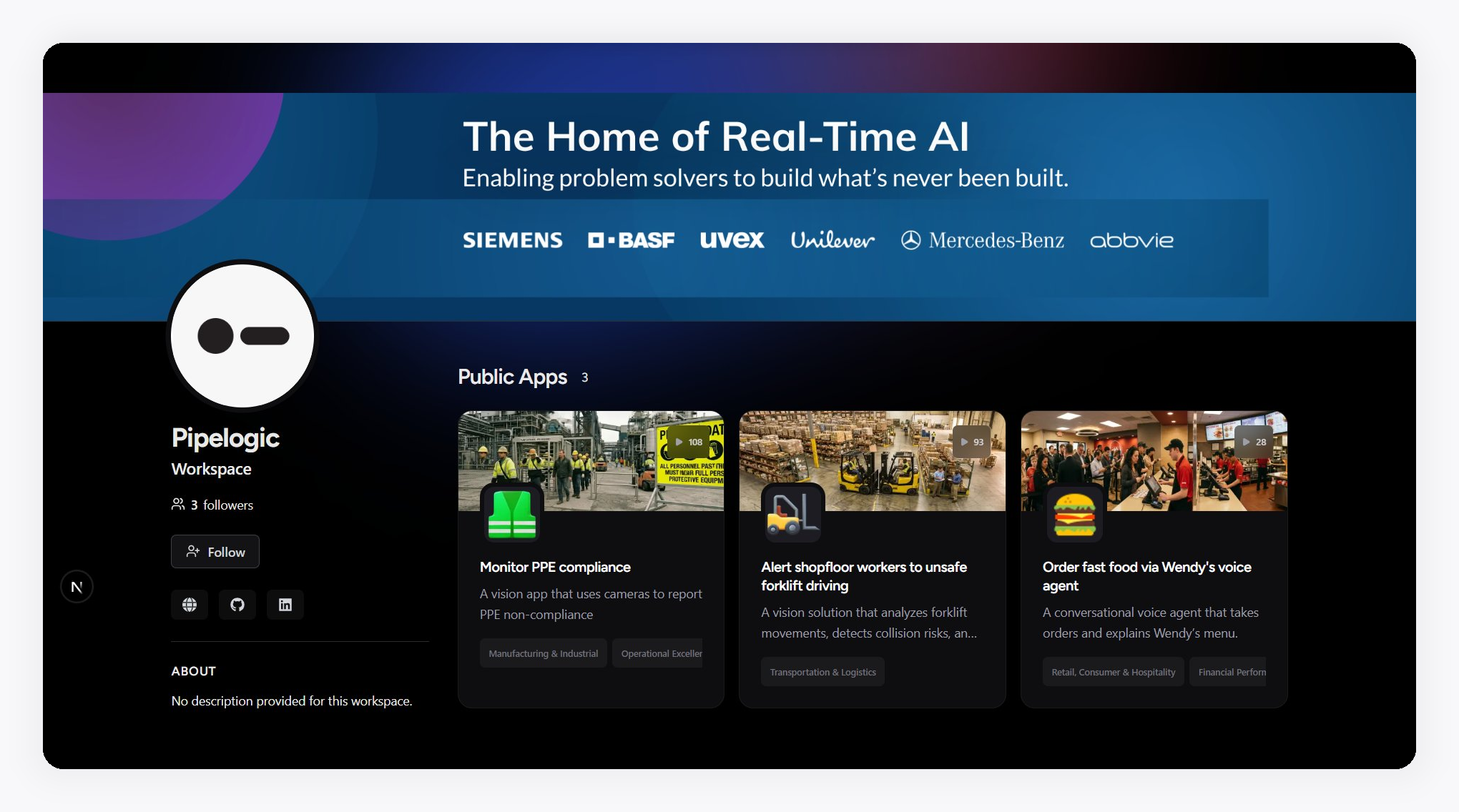
Pipelogic public profiles is a virtual space for individuals and companies where builders can feature the Backends, Apps, and Components they create. Work can be accessible through public URLs, making it easier to share with customers, collaborators, investors, teammates, or the wider community.
That means the open AI movement does not have to stop at model sharing. It can become Solution sharing.
- For a developer, a public profile becomes an AI portfolio that shows working systems instead of static code snippets.
- For a startup, it becomes a product shelf where customers can try what the team is building.
- For a systems integrator, it becomes a live catalog of industry Solutions that can be adapted for new clients.
- For an enterprise team, it becomes a way to share proven internal Solutions across departments, sites, and business units.
The best work should not stay hidden.
Meaningful Solutions can be featured publicly on the Pipelogic Explore page: users can browse reusable components and interactive apps, test examples, and find starting points for their own builds.
Public Profiles make AI work visible. Explore makes it discoverable. Forking makes it reusable. Deployment makes it real.
That is how AI becomes democratic: not by asking every builder to start from scratch, but by giving everyone a path from shared intelligence to usable products.
Deploy where the work happens
Industrial AI does not always belong in one cloud.
Sometimes teams want the fastest possible public demo. Sometimes they want Pipelogic to manage the runtime. Sometimes they need a private cloud or VPC. Sometimes the system has to run on-prem with internet access. Sometimes it has to run in a fully air-gapped environment.
Pipelogic supports the full deployment ladder:
- Public Cloud Runtime for fast demos and public Solutions.
- Pipelogic Managed Cloud for shared or dedicated managed infrastructure.
- Private Cloud / VPC for teams that need their own cloud boundary.
- Connected On-Prem Runtime for deployments on customer hardware with internet access.
- Air-Gapped Runtime for offline and highly controlled environments.
This flexibility is not an enterprise checkbox. It is the difference between a demo and a deployable system.
A factory may need local compute because latency matters. A defense or critical infrastructure environment may need air-gapped deployment. A healthcare or financial services team may need private data residency. A startup may want to begin in managed cloud and move later.
The Backend should not need to be redesigned every time the deployment target changes.
Where Pipelogic fits in the AI stack
Pipelogic is entering a strong ecosystem, and the honest view is that many existing tools are excellent at what they were designed to do.
MLflow is strong for the AI and ML lifecycle: debugging, evaluating, monitoring, optimizing, experiment tracking, and model lifecycle management. Kubeflow is strong for Kubernetes-native AI infrastructure, including portable and scalable ML workflows, model registry, and KServe-based inference on Kubernetes. Node-RED is a proven low-code tool for collecting, transforming, and visualizing real-time data. n8n is strong for workflow automation and AI-enabled integrations, self-hosting, and connecting hundreds of apps and APIs. Roboflow is strong for training computer vision models and deploying them to Roboflow Cloud, self-hosted hardware, and edge devices. Streamlit and Gradio are excellent for quickly building and sharing data apps and ML demos and web interfaces in Python. Hugging Face is the largest community of AI builders sharing models, datasets, spaces, and more.
Pipelogic is different because it brings several layers into one platform:
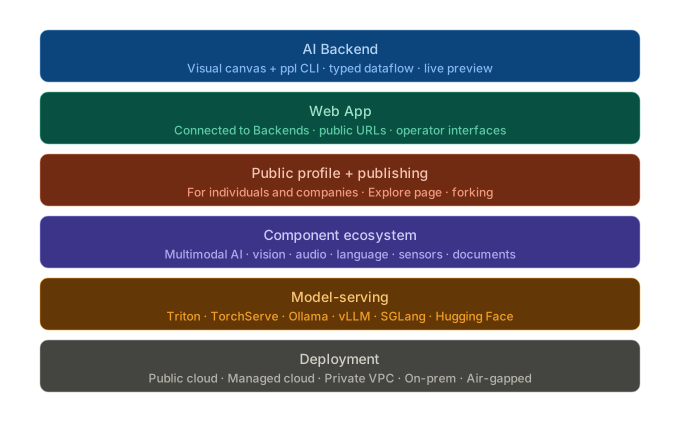
Among the tools compared here, Pipelogic’s special position is the combination. It is not merely a workflow canvas, not merely a model registry, not merely a CV workflow tool, not merely an app framework, and not merely a demo-hosting site.
Pipelogic is a platform for building real-world AI products. It lets teams compose multimodal AI Backends from cameras, microphones, sensors, documents, APIs, models, and business logic; connect those Backends to web Apps; publish reusable Solutions through public profiles; and deploy them across cloud, private, on-prem, or air-gapped environments. The difference is simple: Pipelogic does not stop at the model or the demo. It helps turn AI into a working product.
What can you build?
The better question is not "Which use case does Pipelogic support?"
It is: What real-world signal can you turn into a useful action to solve your challenge?
That signal might be visual, like a camera inspecting a product on a production line. It might be acoustic, like a microphone listening for abnormal machine noise. It might be physical, like a vibration sensor detecting early signs of wear. It might be transactional, like a payment event, an API request, an RFID scan, or a customer speaking to a voice agent.
Pipelogic is built for all of it.
Because most valuable AI products are not single-model demos. They are multimodal systems that connect inputs, models, rules, integrations, and user experiences into one working Solution.
- A manufacturing team can build a quality assurance App that uses cameras, OCR, measurements, and business rules to inspect packaging, labels, defects, and production records.
- A maintenance team can build a predictive maintenance Backend that combines vibration signals, microphones, temperature readings, and historical service logs to identify problems before equipment fails.
- A logistics operator can track big bags, pallets, or containers by combining RFID gates, cameras, weight sensors, forklift activity, and warehouse system data.
- A robotics team can connect perception models, RFID reads, location data, and robot commands so machines can respond to real-world context.
- A restaurant group can build a voice ordering agent that handles the conversation, checks item availability, confirms the order, processes payment, and sends the ticket to the kitchen.
- A finance, legal, or operations team can turn PDFs, emails, APIs, and internal databases into document-processing workflows that extract information, check it against business rules, and trigger the next step.
- A hospital can track assets, route staff attention, or combine sensor data with operational workflows to reduce manual work.
- A farm can analyze audio, video, sensor readings, and activity patterns to monitor livestock, crops, equipment, or feed quality.
The pattern is simple:
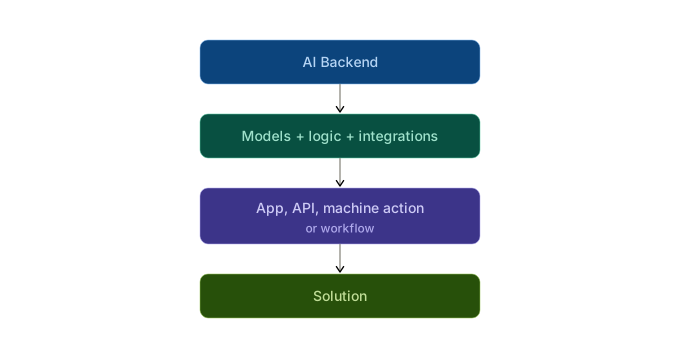
The public Solutions on the Explore page are early examples. They are not the boundary of what Pipelogic can do. They are starting points — examples that builders can try, learn from, fork, adapt, and extend into their own products.
The real opportunity is much larger: any repeatable process that depends on signals, decisions, and actions can become an AI Solution.
Start from something real
The best way to understand Pipelogic is not to read about it for an hour.
It is to run something.
You can start by trying sample AI Apps, browsing public Solutions, and creating a free account with monthly credits. The free plan includes monthly credits, storage, collaborators, public demos, shared cloud runtime, and docs/Discord support.
A practical first path:
- Try a public AI App.
- Open a public Solution.
- Create a free account.
- Fork or recreate the closest Backend.
- Swap the input, model, or output.
- Connect an App or external system.
- Publish the result to your profile.
- Apply for Explore placement if the Solution is meaningful.
- Deploy it where it needs to run.
Pipelogic does not treat the prototype and production system as separate worlds. The same Backend shape can move from early testing toward production runtimes as the use case matures.
Built by systems people
There is a reason Pipelogic feels more like infrastructure than a toy.
The core technology has been built by former competitive programmers who have jointly won more than 50 medals at international olympiads. That background shows up in the product: typed abstractions, performance discipline, reusable components, strong runtime thinking, and an obsession with making complex systems understandable.
More than 24 GB of processed data per second, 5 μs component communication, 400 ms end-to-end inference, and deployment times ranging from 5 seconds for hot deployments to 3 minutes in the public cloud demonstrate the engineering depth behind the core technology.
That kind of engineering matters because real-world AI is full of hard edges.
The camera feed is noisy. The lighting changes. The customer wants a different model. The factory wants on-prem. The enterprise wants audit logs. The user wants a web App. The operator wants an override. The IT team wants air-gapped deployment. The business wants the system live next month, not next year.
Pipelogic was built for that world. Not perfect demos. Working systems.
From one-off AI projects to an AI factory
For too long, industrial and enterprise AI has been built like custom consulting work.
One use case. One integration. One deployment. One vendor dependency. One more system to maintain.
That approach can produce impressive pilots, but it rarely creates momentum. Every new idea starts almost from scratch. Every team rebuilds the same infrastructure. Every customer demo becomes a separate project. Every deployment adds another layer of complexity.
AI should not scale that way.
The next generation of AI adoption will look much more like software product development. Teams will start from proven Solutions, reuse components, swap models, connect new inputs, publish Apps, fork what works, and deploy the same Backend shape across the environment that makes sense — managed cloud, private cloud, on-prem, or air-gapped runtime.
That is the shift Pipelogic is built around.
Pipelogic makes AI work compound:
- A Backend you build today can become the foundation for tomorrow's App.
- A Solution you publish can become a starting point for another team.
- A model you test can be swapped without redesigning the whole system.
- A demo can become a product.
- A product can become a public reference.
- A public reference can become a customer conversation.
That is how AI moves from isolated experiments to repeatable value.
The fastest way to understand Pipelogic is to try something real. Open a public Solution. See how it works. Create an account. Build a Backend. Connect an App. Swap an input, model, or output. Publish your work to a profile. Share it with someone who should see it.
You do not need to begin with a massive transformation program.
Start with one useful signal. Turn it into one useful action. Then build from there.
The world has enough AI demos.
It is time to build AI products people can actually use.
Welcome to Pipelogic.
Start with a public Solution. Create a free account. Build your first Backend. Publish what you make. And if you are building in public, follow Pipelogic on X, GitHub, or Discord so the community can see what you are creating.